Loading...
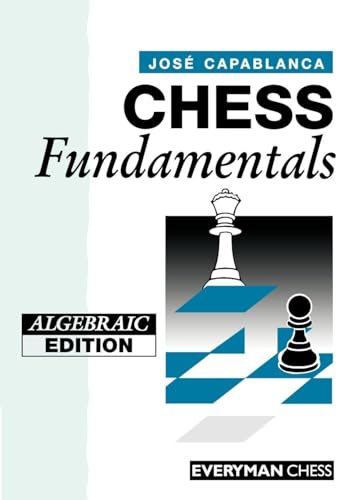
Chess Fundamentals
José Raúl Capablanca
4.6
Published: 1921
Pages: 246
ISBN: 9780486242088
Description
Written by the third World Chess Champion, this timeless classic teaches the essential principles of chess with remarkable clarity. Capablanca's simple yet profound explanations make complex ideas accessible to players of all levels.
Where to Buy
About This Book
Chess Fundamentals by José Raúl Capablanca is one of the most enduring instructional works in chess literature. First published in 1921, this book by the third World Chess Champion has introduced generations of players to the core principles of the game. Capablanca's genius lay not only in his extraordinary playing strength but in his ability to explain complex ideas with crystalline simplicity. José Raúl Capablanca held the World Championship from 1921 to 1927 and was renowned for his seemingly effortless playing style. His games were characterized by technical precision, elegant simplicity, and an almost supernatural ability to find the right move without apparent effort. This natural clarity of thought translates directly into his writing, making Chess Fundamentals one of the most accessible chess books ever produced. The book begins with the most basic elements of chess and builds systematically toward more advanced concepts. Capablanca starts with simple endgame positions — king and pawn endings, rook endings, and basic piece coordination — before moving on to middlegame strategy and opening principles. This endgame-first approach is pedagogically sound, as it teaches players to understand the fundamental properties of the pieces before dealing with the complexity of full-board positions. Capablanca's treatment of the endgame is particularly valuable. He demonstrates essential techniques such as the opposition, the square of the pawn, basic rook endgame principles, and the coordination of king and pieces. These fundamental endgame skills are often neglected by beginners who focus exclusively on openings and tactics, yet they are crucial for converting advantages into wins. The middlegame sections cover essential strategic concepts including the value of the center, the importance of piece activity, pawn structure considerations, and the art of exchanging pieces. Capablanca explains these ideas through carefully selected examples from his own games and those of other masters, always emphasizing understanding over memorization. What distinguishes Chess Fundamentals from other beginner books is the depth of understanding it conveys despite its apparent simplicity. Capablanca does not merely tell readers what to do; he explains why certain principles work. This deeper understanding allows readers to apply the lessons to new positions they encounter in their own games, rather than being limited to memorized patterns. The book's writing style reflects Capablanca's personality as a player: elegant, economical, and precise. There is no wasted prose, no unnecessary complexity. Each sentence conveys useful information, and each example illustrates a clear point. This economy of expression makes the book a pleasure to read and study. Despite being over a century old, the principles Capablanca teaches remain as valid today as when they were written. The fundamentals of chess — piece activity, king safety, pawn structure, the importance of the center — do not change with fashion or theory. A player who thoroughly absorbs the lessons in this book will have a solid foundation for all future chess study. The book has been praised by countless grandmasters and coaches as an ideal starting point for serious chess study. Bobby Fischer reportedly studied it extensively as a young player, and many modern coaches recommend it as the first serious chess book a developing player should read. One notable aspect of Chess Fundamentals is its emphasis on practical play over theoretical knowledge. Capablanca believed that understanding principles was more important than memorizing variations, and this philosophy permeates the book. Readers learn to think about chess positions rather than to recall specific lines, which develops genuine chess understanding. For modern readers, the algebraic notation edition makes the book fully accessible. While some of the specific opening recommendations are outdated, the strategic and endgame content remains entirely relevant. The book serves as both an excellent introduction for beginners and a valuable refresher for experienced players who want to strengthen their fundamental understanding.
What You'll Learn
Master essential endgame techniques including opposition, pawn promotion, and rook endings
Understand the fundamental principles of piece activity and central control
Learn strategic thinking from one of the greatest natural chess talents in history
Develop sound positional judgment through clear, principle-based instruction
Build a solid foundation in pawn structure understanding
Gain practical skills for converting advantages into wins
Who This Book Is For
Chess Fundamentals is ideal for beginners and early intermediate players rated below 1500 who want to build a solid foundation in chess. The book is particularly valuable for players who know the rules but struggle to win games consistently. Its endgame-first approach benefits players who tend to reach winning positions but cannot convert them. More advanced players rated above 1800 may find the material basic but can still benefit from reviewing fundamental principles. The clear writing style makes it accessible to younger players ages 12 and up.
Reader Reviews
Chess Parent
5.0
Bought this for my teenager who was struggling to improve beyond beginner level. Capablanca's clear explanations clicked where other books failed. The endgame-first approach is brilliant — my son now actually wins games he used to draw. A timeless classic.
Returning Player
5.0
Came back to chess after 20 years and this book was the perfect refresher. Capablanca explains things so clearly that complex ideas become obvious. The endgame chapters alone are worth the price. No wonder this book has been in print for over 100 years.
Online Player
4.0
Simple but profound. Don't let the 'fundamentals' title fool you — there's deep wisdom here that even experienced players can benefit from. The only downside is that some opening advice is outdated, but the strategic and endgame content is eternal.