How to Analyze Your Chess Games with Stockfish Without Overtrusting the Engine
A practical guide to reviewing chess games with Stockfish without becoming passive. Learn how to use engine feedback, compare candidate moves, and turn eval swings into real improvement.
Stockfish is one of the best tools a chess player can have, but it is also one of the easiest tools to misuse.
A lot of players open an engine after the game, stare at a number, click through the top line, and walk away feeling like they “did analysis.” In reality, they only watched the engine think.
That is the difference this article is about.
If you want to get stronger, the goal is not just to run Stockfish. The goal is to learn from Stockfish without letting it do all the thinking for you.
This guide explains a practical review method that keeps you in the loop, helps you understand why the evaluation changes, and makes engine analysis far more useful for actual improvement.
The Main Mistake: Treating the Eval Bar Like a Verdict
The most common mistake in engine review is simple: players see +1.8, assume White is “better,” and move on without understanding what that advantage means.
But a number by itself is not a lesson.
Sometimes +1.8 means:
- you are winning material soon
- your opponent's king is in danger
- one side has a healthier pawn structure
- a piece is trapped
- a tactical sequence is available if you calculate accurately
Those are very different situations.
If you do not know which one the engine is talking about, then the number is not helping you very much.
That is why good review starts with a better question:
Why did the evaluation change here?
Not “What is the best move?” first. “Why did the position become better or worse?”
What Stockfish Is Great At
Stockfish is excellent at things humans miss:
- tactical shots hidden a few moves deep
- quiet defensive moves that hold a position together
- small move-order details in sharp lines
- resourceful moves in bad positions
That makes it incredibly valuable.
If you are reviewing a game in the analysis board, Stockfish is perfect for testing your assumptions. It can show you whether your attack was real, whether your sacrifice worked, or whether the endgame you entered was actually lost.
What Stockfish Is Not Great At Teaching by Itself
The engine does not naturally explain positions in the way a human learner needs.
It does not begin with:
- “your dark squares became weak after this pawn move”
- “you traded the only defender of your king”
- “this endgame is unpleasant because your rook became passive”
Instead, it gives the answer first.
That is useful if you already know what you are looking for. It is much less useful if you are still trying to build judgment.
So the trick is not to ignore Stockfish. The trick is to insert your own thinking before and after the engine output.
A Better Review Process
Here is the process I recommend to most improving players.
1. Replay the Game Once Without the Engine
Before turning Stockfish on, go through the game quickly and mark the moments that felt important.
Ask yourself:
- where did I feel comfortable?
- where did I start getting confused?
- where did the game turn?
- which move would I most want back?
That first pass matters because it preserves your own understanding of the game. If you skip it, the engine can erase your memory of what you were actually thinking over the board.
2. Turn the Engine On and Find the Biggest Swing
Once Stockfish is running, do not inspect every move equally.
Look for the position where the evaluation changed sharply. That is usually where the real lesson is.
If the eval bar jumps after move 18, that is where your attention should go first — not move 7, unless move 7 caused the later collapse in a clear way.
This alone makes analysis more efficient.
Do Not Stop at the Best Move
A lot of players make another mistake here: they see the engine's top move and assume that is the whole lesson.
Usually it is not.
The more useful habit is to compare:
- the move you played
- the engine's best move
- one or two other candidate moves
That comparison tells you what kind of decision the position required.
Sometimes the lesson is:
- “I needed a defensive move, not an active one.”
- “I should have improved my worst piece before attacking.”
- “I rushed a pawn break before I finished development.”
Those are reusable ideas. “The best move was Qg4” often is not.
Ask Human Questions, Not Just Engine Questions
When you reach a critical position, try questions like these:
- Which king is less safe?
- Which piece is poorly placed?
- Is one side ahead in development?
- What changed after the last pawn move?
- Is the engine recommending a tactical move or a prophylactic one?
These questions help translate the engine's output into practical understanding.
They also protect you from a common trap: copying a move you would never find in a real game because you never understood the position that produced it.
What To Do When the Engine Suggests a "Computer Move"
Sometimes Stockfish recommends a move that looks deeply unnatural.
When that happens, do not panic and do not immediately assume your human move was “stupid.” Instead, ask:
- Is this move only best because of a hidden tactic?
- Is there a simpler move that keeps most of the advantage?
- Would I realistically find this move in a practical game?
This matters because your goal is not to become a worse human in service of perfect computer lines. Your goal is to become a better player.
If the engine's top move is a one-off tactical resource, the practical lesson may be the tactical motif, not the exact move itself.
Translate Every Critical Position into Plain Language
One of the best habits in engine review is to write a one-sentence summary of the lesson.
For example:
- “I attacked before my king was safe.”
- “I opened the center while behind in development.”
- “I traded into an endgame where my pawns were weak.”
- “I ignored my opponent's only active counterplay.”
That sentence is often more valuable than ten more minutes of clicking through Stockfish variations.
Why? Because you can remember it during the next game.
Use Stockfish To Confirm, Not To Outsource Judgment
A good mental model is this:
- you identify the important moment
- Stockfish checks whether your evaluation was right
- you explain the practical lesson in human terms
That keeps the engine in the correct role.
It becomes a testing partner, not a substitute for thought.
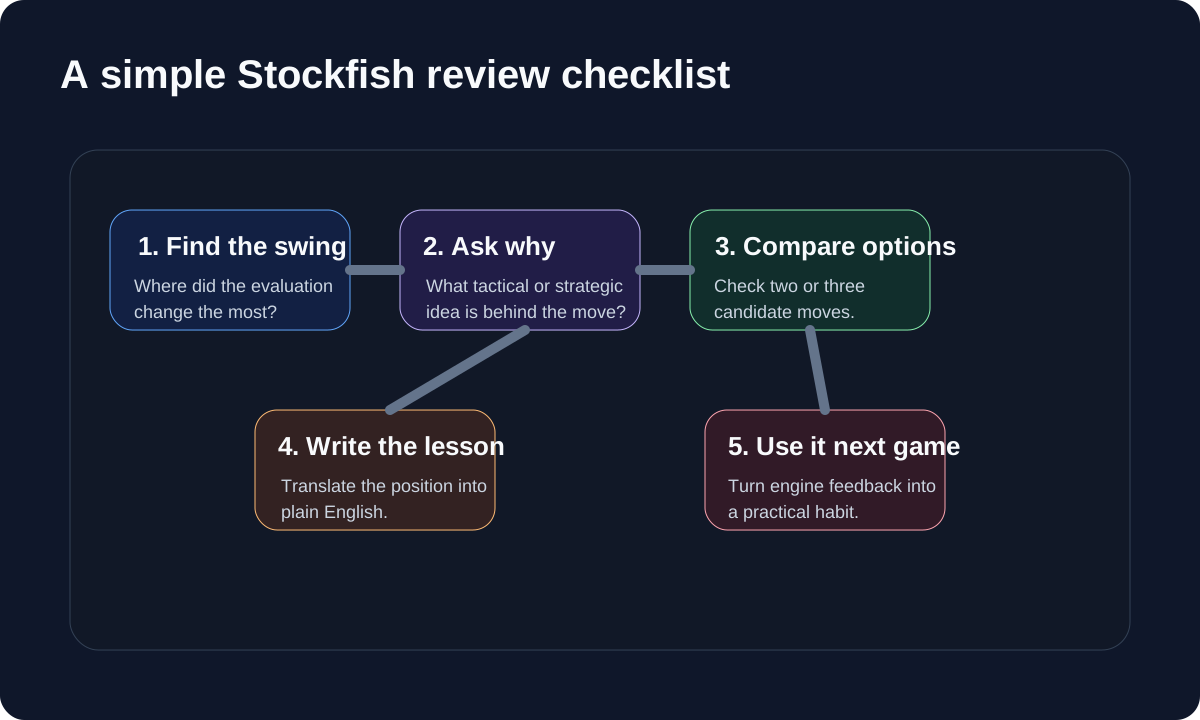
A Simple Five-Step Method You Can Reuse
If you want a repeatable review loop, use this one:
- replay the game once without Stockfish
- turn the engine on and find the biggest swing
- compare your move with two or three alternatives
- ask what strategic or tactical idea explains the change
- write one practical lesson before you leave the board
That is enough.
You do not need to inspect every move for twenty minutes unless the game really deserves it.
When To Ignore Minor Engine Complaints
Not every engine disagreement matters.
If Stockfish prefers one quiet move over another by 0.2, that may not be the best use of your study time unless you are already a very strong player.
Most club players gain more from focusing on:
- blunders
- missed tactics
- poor king safety decisions
- inaccurate exchanges
- strategic plans that clearly changed the evaluation
This is a big part of not overtrusting the engine. You do not need to treat every tiny centipawn shift as a life lesson.
Where AI Can Help
If you want a bridge between raw engine output and plain-language explanation, this is exactly where a tool like AI Coach becomes useful.
The engine is still valuable, but AI explanation can help you answer the question most players actually care about:
Why was this move a mistake in practical terms?
That makes it easier to move from “the eval dropped” to “I understand what I missed.”
Final Thought
Stockfish is not the problem. Passive review is the problem.
When players say engine analysis is not helping them improve, the issue is often not that the engine is too strong. It is that they are letting the engine do all the interpretation.
If you keep your own questions alive, compare candidate moves, and turn critical positions into plain-language lessons, Stockfish becomes one of the best training tools you can use.
Just do not ask it to replace your judgment. Ask it to sharpen it.