Loading...
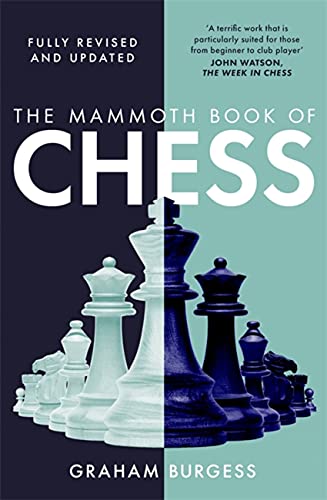
The Mammoth Book of Chess
Graham Burgess
4.4
Published: 2021
Pages: 624
ISBN: 9781472146328
Description
A comprehensive all-in-one chess reference covering openings, tactics, strategy, endgames, and the history of chess. Now in its fourth edition, this massive volume by FM Graham Burgess is one of the most complete single-volume chess guides available.
Where to Buy
About This Book
The Mammoth Book of Chess by FIDE Master Graham Burgess is one of the most comprehensive single-volume chess references ever published. Now in its fourth edition, updated and expanded in 2021, this massive 624-page book covers virtually every aspect of the game, from basic rules to advanced strategy, making it an invaluable resource for players at all levels. Graham Burgess is a FIDE Master, prolific chess author, and the editorial director of Gambit Publications, one of the world's leading chess publishing houses. He holds a Guinness World Record for the longest chess marathon and has written or co-authored over 25 chess books. His extensive experience in both playing and publishing gives him a unique ability to present complex material in an organized and accessible manner. The book is divided into several major sections, each covering a different aspect of chess. The opening section provides a comprehensive survey of all major chess openings, from classical systems like the Ruy Lopez and Queen's Gambit to modern favorites like the Sicilian Defense and King's Indian. Each opening is explained with key ideas, typical plans, and critical variations, giving readers a solid foundation for building their opening repertoire. The tactics section covers all the fundamental tactical motifs including forks, pins, skewers, discovered attacks, double checks, and more complex themes like deflection, decoy, and interference. Burgess presents these concepts with clear examples and exercises, helping readers develop the pattern recognition skills essential for competitive play. The strategy section addresses positional concepts including pawn structure, piece activity, space advantage, weak squares, and the interplay between strategy and tactics. Burgess explains these ideas with annotated games from chess history, showing how the greatest players have applied strategic principles in practice. The endgame section covers essential endgame knowledge from basic king and pawn endings to complex rook endings and minor piece endings. Burgess focuses on the most practically important positions and techniques, ensuring that readers develop the endgame skills most likely to arise in their own games. Beyond pure instruction, the book includes a fascinating section on chess history, featuring profiles of world champions and landmark games that shaped the development of chess. This historical context enriches the reader's appreciation of the game and provides inspiration for their own play. The fourth edition has been significantly updated to reflect modern developments in chess theory and practice. New opening variations, recent grandmaster games, and updated analysis ensure that the content remains relevant in the age of powerful chess engines. Burgess has also expanded the exercise sections, providing more opportunities for readers to test their understanding. One of the book's greatest strengths is its organization. Despite covering an enormous range of material, the book is well-structured and easy to navigate. Clear headings, diagrams, and cross-references help readers find the information they need quickly. The book works equally well as a cover-to-cover study guide and as a reference to consult when specific questions arise. The writing style is clear and informative without being dry. Burgess manages to convey complex ideas in straightforward language, making the book accessible to beginners while still providing enough depth to interest experienced players. The balance between breadth and depth is carefully maintained throughout.
What You'll Learn
Build a comprehensive understanding of all major chess openings and their key ideas
Master essential tactical patterns and develop sharp combinational vision
Learn fundamental strategic principles for evaluating and planning in any position
Develop practical endgame skills for the most common ending types
Understand the historical development of chess ideas through landmark games
Create a solid all-round chess foundation covering every phase of the game
Who This Book Is For
The Mammoth Book of Chess is ideal for beginners and intermediate players rated up to 1800 who want a comprehensive single-volume chess reference. It is particularly well-suited for adult beginners returning to chess, parents supporting young players, and club players who want a reliable reference covering all aspects of the game. The book's breadth makes it an excellent starting point, though players seeking deep expertise in any single area will eventually need more specialized books. Advanced players above 2000 may find the material too general, but will still appreciate it as a quick reference.
Reader Reviews
Returning Player
5.0
I played chess as a kid and wanted to get back into it. This book is perfect for that. It covers everything you need in one volume: openings, tactics, strategy, endgames. The fourth edition is well-updated and the explanations are clear. Best all-in-one chess book I have found.
Chess Parent
4.0
Bought this as a reference for my family. It is comprehensive and well-organized. My teenage son uses it to study openings and my husband reads the strategy sections. Good value for the amount of content. Some sections could go deeper, but that is the trade-off with an all-in-one book.
Club Player
4.0
An excellent reference book that I keep coming back to. The opening survey alone is worth the price. The tactics and strategy sections are solid, and the historical content is enjoyable. Not a deep dive into any single topic, but the best single-volume overview of chess I have seen.