Loading...
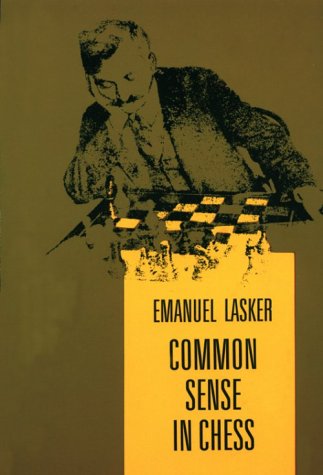
Common Sense in Chess
Emanuel Lasker
4.3
Published: 1896
Pages: 128
ISBN: 9780486214405
Description
World Champion Emanuel Lasker's classic lectures on chess fundamentals. Covers openings, middlegame, and endgame principles with timeless wisdom. Lasker's emphasis on practical thinking and common sense makes this book eternally relevant.
Where to Buy
About This Book
Common Sense in Chess by Emanuel Lasker is a timeless classic of chess instruction, written by the second World Chess Champion who held the title for an unprecedented 27 years. Originally published in 1896 based on a series of lectures Lasker delivered in London, this concise work presents the fundamentals of chess with a clarity and wisdom that remain relevant more than a century later. Emanuel Lasker was not only a chess genius but also a mathematician, philosopher, and original thinker. His approach to chess was fundamentally practical: he believed that chess should be played with common sense rather than rigid rules. This philosophy permeates the book and gives it a freshness that many more modern instructional works lack. The book is organized as a series of twelve lectures covering the opening, middlegame, and endgame. Each lecture is concise and focused, presenting key principles without unnecessary complexity. Lasker's gift for distilling complex ideas into simple, memorable statements makes the material accessible to players of all levels. The opening lectures establish fundamental principles that every player should know: control the center, develop your pieces, castle early, and don't move the same piece twice without good reason. While these principles are now standard in chess instruction, Lasker was among the first to articulate them clearly for a general audience. His explanations of why these principles work, rather than just stating them as rules, help readers develop genuine understanding. The middlegame lectures cover the art of planning and the evaluation of positions. Lasker emphasizes the importance of understanding the position before making a move, rather than calculating variations blindly. He teaches readers to identify the key features of a position and formulate plans that address those features. This practical approach to chess thinking remains the foundation of good play. The endgame lectures cover essential endgame knowledge with characteristic economy. Lasker focuses on the most important principles and positions, avoiding the encyclopedic approach that can overwhelm beginners. His treatment of king and pawn endings is particularly clear, establishing the fundamental concepts that all endgame understanding builds upon. What makes Common Sense in Chess special is Lasker's philosophical approach to the game. He doesn't just teach moves and variations; he teaches a way of thinking about chess. His emphasis on practical judgment over theoretical knowledge reflects his own playing style, which relied on understanding opponents and positions rather than memorizing opening theory. Lasker's writing style is elegant and accessible. Despite being written in the Victorian era, the prose remains clear and engaging for modern readers. His analogies and explanations have a timeless quality that transcends the specific chess positions discussed. The book's brevity is actually one of its strengths. At just 128 pages, it can be read in a few sittings, yet it contains enough wisdom to improve any player's game. Lasker understood that the most important chess principles are few in number and can be stated simply. His ability to identify and communicate these essential truths is what makes this book a classic. Common Sense in Chess has influenced generations of chess players and teachers. Its emphasis on practical thinking, clear principles, and common sense over memorization resonates as strongly today as it did when Lasker first delivered these lectures. For players who want to understand the fundamental principles of chess from one of the greatest minds in the game's history, this book is an invaluable treasure.
What You'll Learn
Understand the fundamental principles of chess opening play from a World Champion's perspective
Develop practical middlegame thinking based on position evaluation rather than memorization
Learn essential endgame principles presented with clarity and economy
Build a common-sense approach to chess that emphasizes understanding over rigid rules
Gain insight into the philosophical foundations of good chess thinking
Study timeless chess wisdom from one of the greatest champions in history
Who This Book Is For
Common Sense in Chess is ideal for beginner to intermediate players rated between 800 and 1500 who want to learn fundamental chess principles from one of the greatest champions in history. It is particularly well-suited for adult beginners who appreciate clear, thoughtful instruction and for players who prefer understanding principles over memorizing variations. Chess history enthusiasts will value the book's historical significance. The brevity makes it accessible to readers with limited study time. Advanced players may find the material too basic but can appreciate Lasker's philosophical approach to the game.
Reader Reviews
Chess Philosopher
5.0
Lasker's genius shines through every page. This tiny book contains more chess wisdom than many 500-page modern works. His emphasis on common sense and practical thinking is exactly what most improving players need. A masterpiece that has aged beautifully.
Beginner Player
4.0
A wonderful introduction to chess thinking from a World Champion. The lectures are clear and the principles are immediately useful. Some of the language is a bit old-fashioned, but the ideas are timeless. Perfect for beginners who want to understand chess rather than just memorize moves.
Chess Historian
5.0
Reading Lasker is a privilege. His practical approach to chess was revolutionary in his time and remains refreshing today. This book proves that the fundamentals of chess don't change, and that clear thinking trumps memorization at every level. Essential reading.