Loading...
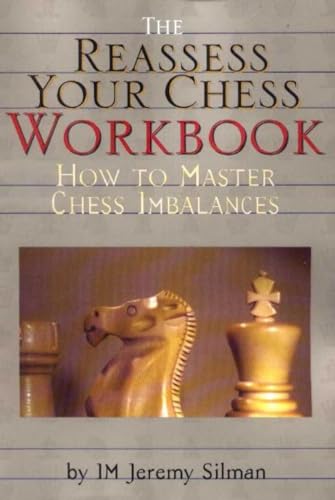
The Reassess Your Chess Workbook
Jeremy Silman
4.5
Published: 2001
Pages: 423
ISBN: 9781890085050
Description
The companion workbook to Silman's classic How to Reassess Your Chess. Contains 131 carefully selected positions for the reader to solve, with detailed solutions explaining the thought process behind each answer.
Where to Buy
About This Book
The Reassess Your Chess Workbook by International Master Jeremy Silman is the essential companion to his landmark book How to Reassess Your Chess. While the original book teaches the theory of imbalances and positional evaluation, this workbook provides the hands-on practice needed to internalize those concepts and apply them in actual games. With 131 carefully selected positions, it transforms theoretical knowledge into practical skill. Silman designed this workbook after years of teaching experience revealed a common problem: students could understand his imbalance concepts when explained but struggled to apply them independently. The workbook bridges this gap by presenting positions where readers must identify the imbalances, formulate plans, and find the best moves on their own before checking the detailed solutions. Each position in the workbook is drawn from real games and chosen to illustrate specific imbalance themes. Some positions focus on a single imbalance, such as a superior minor piece or a pawn structure advantage. Others present complex situations where multiple imbalances interact, requiring the reader to weigh competing factors and determine which imbalance is most important. The solutions are where the workbook truly shines. Silman doesn't just give the correct move; he provides a complete analysis of the position using his imbalance framework. He explains what imbalances exist, how they should influence the plan, and why the recommended move is the best way to exploit the position's characteristics. These detailed solutions serve as additional lessons that deepen understanding. Silman also includes common wrong answers and explains why they are incorrect. This is invaluable because it helps readers identify and correct flawed thinking patterns. Many improving players make the same types of strategic errors repeatedly, and seeing these mistakes analyzed and explained helps break bad habits. The positions are organized by difficulty, progressing from relatively straightforward imbalance assessments to complex positions that challenge even strong players. This graduated approach allows readers to build confidence with simpler positions before tackling more demanding material. The difficulty ratings help readers choose positions appropriate to their current level. One of the workbook's most valuable features is its emphasis on the thinking process. Silman encourages readers to spend significant time on each position before looking at the solution. He recommends writing down your analysis, including the imbalances you identify and the plan you formulate. This active engagement with the material accelerates learning far more than passive reading. The workbook can be used independently, but it is most effective when studied alongside How to Reassess Your Chess. Readers who have absorbed the theoretical framework from the main book will find the workbook positions perfectly designed to test and reinforce their understanding. Together, the two books form a comprehensive course in positional chess. For players who have read How to Reassess Your Chess but feel they haven't fully internalized the concepts, this workbook is the missing piece. It provides the deliberate practice needed to transform theoretical knowledge into intuitive understanding that manifests naturally during games.
What You'll Learn
Apply Silman's imbalance theory to real game positions through hands-on practice
Develop the ability to independently identify positional imbalances and formulate plans
Recognize and correct common strategic thinking errors through detailed wrong-answer analysis
Build intuitive positional understanding through 131 carefully graded exercises
Strengthen the connection between theoretical knowledge and practical application
Improve your chess thinking process through structured position analysis practice
Who This Book Is For
The Reassess Your Chess Workbook is designed for players rated between 1400 and 2000 who have read or are reading How to Reassess Your Chess and want to practice applying the imbalance concepts. It is ideal for self-study players who learn best through active problem-solving rather than passive reading. Chess coaches will find it an excellent source of training positions for intermediate students. Players who have not read the main book can still benefit, but the workbook is most effective when used as a companion to Silman's theoretical framework.
Reader Reviews
Silman Student
5.0
This workbook was the key to actually applying what I learned in How to Reassess Your Chess. Reading about imbalances is one thing; finding them yourself is another. After working through these 131 positions, the concepts became second nature. My positional play improved enormously.
Improving Player
4.0
Excellent companion to the main book. The positions are well-chosen and the solutions are incredibly detailed. I especially appreciated the analysis of wrong answers - it helped me identify thinking patterns I needed to fix. Highly recommended for 1400-1900 players.
Chess Coach
5.0
I assign positions from this workbook to my students regularly. The graduated difficulty and detailed solutions make it perfect for structured training. Students who work through this book alongside the main text show dramatic improvement in their positional understanding.