Loading...
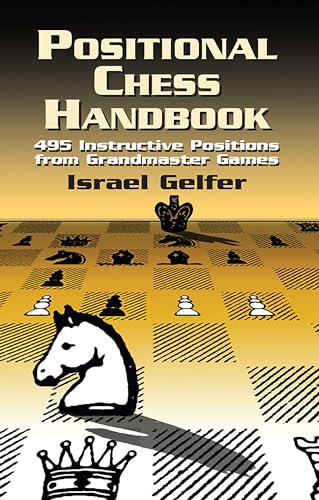
Positional Chess Handbook: 495 Instructive Positions from Grandmaster Games
Israel Gelfer
4.4
Published: 1991
Pages: 256
ISBN: 9780486253060
Description
A collection of 495 carefully selected positions from grandmaster games, each illustrating a key positional concept. Gelfer provides concise explanations that help readers develop their positional intuition through pattern recognition and practical examples.
Where to Buy
About This Book
Positional Chess Handbook by Israel Gelfer is a unique and highly effective training tool that develops positional understanding through the study of 495 carefully selected positions from grandmaster games. Published by Dover in 1991, this compact but dense book has earned a devoted following among players who want to improve their strategic play through pattern recognition and practical examples. Israel Gelfer was an Israeli chess master and trainer who understood that positional chess skill develops not through abstract theorizing but through exposure to a large number of well-chosen examples. His approach in this book is simple but powerful: present a position, ask the reader to find the best continuation, and then explain the positional principle that guides the correct choice. The book's format is its greatest strength. Each position occupies roughly half a page, with a clear diagram, a brief setup description, and a concise solution with explanation. This compact format allows readers to study many positions in a single session, building positional pattern recognition through volume and repetition. The approach mirrors how tactical skill is developed through puzzle solving, but applied to positional themes. The 495 positions are organized by strategic theme, covering topics such as weak squares, pawn structure exploitation, piece activity, the bishop pair advantage, good and bad bishops, knight outposts, open files, the seventh rank, prophylaxis, and many more. This thematic organization allows readers to focus on specific areas of positional play that need improvement. The positions are drawn from games by the greatest positional players in chess history, including Capablanca, Petrosian, Karpov, Rubinstein, Smyslov, and many others. By studying how these masters handled positional challenges, readers absorb the thinking patterns and evaluative skills that characterize strong positional play. Gelfer's explanations are notably concise. Rather than lengthy prose discussions, he provides focused commentary that highlights the key positional idea in each position. This economy of expression respects the reader's time and keeps the focus on the chess content. The brevity also makes the book ideal for repeated study — readers can work through the entire collection multiple times, reinforcing their positional understanding with each pass. One of the book's most valuable aspects is its emphasis on practical decision-making. The positions are taken from actual games, not composed studies, so they reflect the complexity and ambiguity of real chess. Readers must evaluate positions with multiple factors in play and choose the continuation that best addresses the positional requirements. This practical orientation develops judgment that transfers directly to competitive play. The difficulty level of the positions varies, with some being relatively straightforward and others requiring sophisticated positional understanding. This range makes the book useful for a broad spectrum of players, from intermediate club players to advanced tournament competitors. Even strong players can benefit from the systematic review of positional themes. The book works well as both a training tool and a reference. Players can work through it sequentially for comprehensive positional training, or they can focus on specific thematic sections to address particular weaknesses. The thematic index makes it easy to find positions related to any specific positional concept. For players who have developed solid tactical skills but struggle with positional play, this book provides an efficient path to improvement. The pattern recognition approach builds positional intuition — the ability to sense the right move in a position without extensive calculation. This intuition is what separates strong positional players from those who rely solely on tactics. The Dover edition is affordably priced, making it accessible to players at all budget levels. Despite its modest price, the instructional content is substantial and the quality of the selected positions is high. Many coaches consider it one of the best value-for-money chess books available. Positional Chess Handbook has stood the test of time because its approach to positional training is fundamentally sound. The principles illustrated in these 495 positions are timeless aspects of chess that appear in games at every level. A player who works through this collection carefully will develop a significantly stronger positional foundation.
What You'll Learn
Develop positional intuition through 495 carefully selected grandmaster positions
Master key strategic themes including weak squares, pawn structure, and piece activity
Learn to recognize positional patterns that guide correct decision-making
Study the positional techniques of Capablanca, Petrosian, Karpov, and other masters
Build practical positional judgment through pattern recognition training
Strengthen understanding of bishop pair advantages, knight outposts, and open files
Who This Book Is For
Positional Chess Handbook is designed for intermediate players rated between 1300 and 1900 who want to develop their positional understanding through practical training. The book assumes basic familiarity with chess notation and fundamental strategic concepts. It is particularly valuable for players who have strong tactical skills but weak positional play, as the pattern recognition approach builds strategic intuition efficiently. Beginners who have not yet developed basic tactical awareness should focus on tactics first. Advanced players above 2000 can use the book as a review tool but may find many positions straightforward.
Reader Reviews
Club Player
5.0
This book is like a gym workout for positional chess. Working through the 495 positions systematically improved my strategic understanding more than any other single book. The concise format means you can study 10-20 positions in a sitting. Incredible value.
Chess Coach
4.0
I use this as a training resource for my intermediate students. The thematic organization makes it easy to assign positions targeting specific weaknesses. The positions are well-chosen and the explanations are clear. A practical and effective training tool.
Online Player
4.0
Great positional training book at an unbeatable price. The positions are challenging enough to make you think but not so difficult that they're discouraging. I went through it twice and noticed significant improvement in my positional play both times.