Loading...
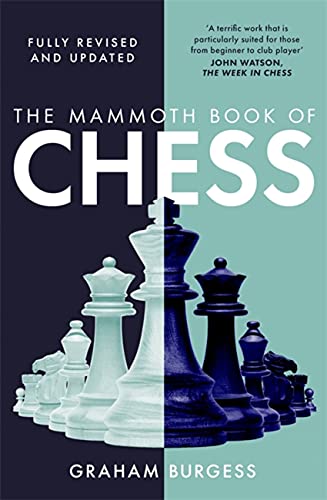
The Mammoth Book of Chess
Graham Burgess
4.3
Published: 2009
Pages: 576
ISBN: 9780762437269
Description
A comprehensive one-volume chess encyclopedia covering openings, tactics, strategy, endgames, and the history of chess. Burgess provides everything a developing player needs in a single accessible reference, making it an ideal companion for players building their chess knowledge.
Where to Buy
About This Book
The Mammoth Book of Chess by Graham Burgess is one of the most comprehensive single-volume chess references available. Spanning over 500 pages, this ambitious work covers virtually every aspect of chess — from basic rules and tactics to advanced strategy, opening theory, endgame technique, and chess history — making it an invaluable resource for developing players who want a complete chess education in one book. Graham Burgess is a FIDE Master, experienced chess coach, and prolific author who has written and edited numerous chess books. He holds a Guinness World Record for marathon chess playing and brings both practical experience and pedagogical skill to this comprehensive guide. His ability to present complex material in an organized and accessible manner makes this book effective for a wide range of readers. The book is divided into major sections that cover the full spectrum of chess knowledge. The opening section provides a survey of all major opening systems, explaining the key ideas and typical plans for both sides. Rather than overwhelming readers with long variation trees, Burgess focuses on the strategic concepts behind each opening, helping readers understand what they are trying to achieve rather than memorizing specific move orders. The tactics section covers all fundamental tactical motifs with clear examples and exercises. Pins, forks, skewers, discovered attacks, double checks, and more complex combinational themes are explained systematically. The exercises allow readers to test their understanding and develop pattern recognition skills that translate directly into improved game results. The strategy section addresses positional chess concepts including pawn structure, piece activity, space advantage, weak squares, and the art of planning. Burgess draws on classic examples from chess history to illustrate these concepts, showing how the greatest players have applied strategic principles in their games. The explanations are clear enough for beginners while containing enough depth to benefit intermediate players. The endgame section covers essential theoretical positions and practical endgame principles. Burgess explains key concepts such as the opposition, basic checkmates, rook endgame fundamentals, and the principles of king and pawn endings. While not as comprehensive as dedicated endgame manuals, this section provides a solid foundation for practical endgame play. One of the book's unique features is its coverage of chess history and culture. Burgess includes profiles of great players, accounts of famous matches, and discussions of how chess has evolved over the centuries. This historical context enriches the reader's appreciation of the game and provides inspiration for their own chess journey. The book also addresses practical aspects of chess that many instructional works neglect. Sections on tournament preparation, time management, psychological factors, and how to study chess effectively provide guidance that helps readers translate their knowledge into competitive results. These practical tips are particularly valuable for players transitioning from casual to competitive play. The Mammoth Book of Chess is organized for both sequential reading and reference use. Players can work through the book from beginning to end for a comprehensive chess education, or they can dip into specific sections as needed. The clear organization and detailed table of contents make it easy to find information on any topic. For players who are overwhelmed by the sheer number of chess books available and don't know where to start, this book provides an ideal solution. It covers all the essential topics in a single volume, giving readers a solid foundation in every aspect of the game. From this foundation, players can then pursue more specialized books on topics that particularly interest them. The book has been updated through multiple editions to include modern games and current theoretical developments. While the fundamental principles of chess don't change, the inclusion of contemporary examples keeps the material fresh and relevant. The latest edition reflects the influence of computer analysis on modern chess understanding. Critics note that the book's breadth necessarily limits its depth in any single area. Players seeking exhaustive coverage of openings, endgames, or strategy will eventually need more specialized resources. However, as a starting point and general reference, The Mammoth Book of Chess is difficult to surpass.
What You'll Learn
Gain a comprehensive understanding of all aspects of chess in a single volume
Learn the key ideas behind every major chess opening system
Master fundamental tactical patterns through clear examples and exercises
Understand essential strategic concepts including pawn structure and piece activity
Build a foundation in endgame play covering key theoretical positions
Develop practical skills for tournament preparation and competitive play
Who This Book Is For
The Mammoth Book of Chess is ideal for beginners and early intermediate players rated below 1500 who want a comprehensive introduction to all aspects of chess. It is particularly well-suited for players who prefer having a single reference rather than multiple specialized books. The book is accessible to adult beginners and older teenagers. More advanced players rated above 1600 will find the coverage too broad and shallow for their needs, though it can still serve as a useful quick reference. Players looking for deep coverage of any single topic should supplement this book with more specialized works.
Reader Reviews
New Player
5.0
This book has everything a beginner needs. Instead of buying five different books on openings, tactics, strategy, and endgames, I got it all in one place. The explanations are clear and the organization makes it easy to find what I need. Best chess investment I've made.
Casual Player
4.0
Great all-in-one reference for developing players. Covers every topic you need with enough depth to be useful without being overwhelming. I keep it next to my chess board and refer to it regularly. The historical sections are a nice bonus.
Chess Parent
4.0
Bought this for my family and we all use it. The kids refer to the tactics section, I study the strategy chapters, and we all enjoy the chess history. Not the deepest coverage of any single topic, but the breadth is impressive and the writing is accessible.