Loading...
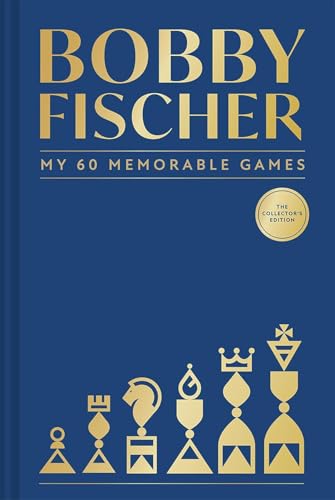
My 60 Memorable Games
Bobby Fischer
4.9
Published: 1969
Pages: 384
ISBN: 9780923891381
Description
Bobby Fischer's personal selection and annotation of his 60 best games, widely considered one of the finest game collections ever published. Fischer's brutally honest and deeply instructive annotations reveal the mind of the greatest chess player of his era.
Where to Buy
About This Book
My 60 Memorable Games by Bobby Fischer stands as one of the supreme achievements in chess literature. Published in 1969, three years before Fischer won the World Championship, this collection of self-annotated games reveals the extraordinary depth of understanding that made Fischer the dominant player of his generation. The book is widely regarded as the finest game collection by a single player ever published. Bobby Fischer's place in chess history is unique. He single-handedly challenged Soviet chess supremacy during the Cold War, becoming the eleventh World Chess Champion in 1972 with his legendary victory over Boris Spassky in Reykjavik. His playing style combined deep opening preparation, precise calculation, relentless fighting spirit, and an almost inhuman will to win. All of these qualities are on display in this remarkable book. The sixty games span Fischer's career from 1957 to 1967, covering his development from a teenage prodigy to the strongest player in the Western world. The selection includes victories against the greatest players of the era — Tal, Petrosian, Spassky, Keres, Geller, Reshevsky, and many others — as well as a few losses that Fischer analyzes with characteristic honesty. What makes Fischer's annotations exceptional is their combination of depth and clarity. Unlike many grandmaster annotations that either oversimplify or drown readers in variations, Fischer strikes a perfect balance. He provides enough concrete analysis to justify his assessments while explaining the strategic ideas behind his moves in accessible prose. The result is annotations that are both rigorous and instructive. Fischer's honesty as an annotator is remarkable. He does not shy away from pointing out his own mistakes, missed opportunities, and moments of uncertainty. When he loses, he explains where he went wrong without making excuses. This candor makes the book far more instructive than collections where the author presents himself as infallible. The games themselves are masterpieces of chess art. Fischer's style was characterized by classical clarity — he preferred positions where the logic of the game was transparent and the better player would prevail through superior understanding rather than luck or bluff. His games demonstrate the power of sound positional play combined with tactical sharpness. Several games in the collection have become legendary in chess culture. His "Game of the Century" against Donald Byrne, played when Fischer was just 13, showcases a stunning queen sacrifice. His demolition of the Najdorf Sicilian against various opponents demonstrates his deep opening preparation. His endgame technique in several games reveals a level of precision that few players have matched. The book also provides valuable insight into Fischer's opening preparation, which was far ahead of its time. Fischer's deep analysis of specific opening variations, particularly in the Sicilian Defense and the Ruy Lopez, influenced opening theory for decades. Many of his innovations remain relevant in modern practice. For students of chess, My 60 Memorable Games offers lessons in virtually every aspect of the game. The opening play demonstrates the importance of preparation and understanding. The middlegame combinations show how tactical opportunities arise from sound positional play. The endgame technique illustrates how to convert small advantages with precision. The book's influence on chess culture extends beyond its instructional value. It established the standard for how game collections should be annotated and inspired countless players to study chess more seriously. Many professional players cite it as the book that most influenced their development. Modern readers should note that while engine analysis has revealed some inaccuracies in Fischer's annotations, the strategic insights and thinking processes he describes remain invaluable. The book teaches not just specific moves but a way of approaching chess that develops genuine understanding.
What You'll Learn
Study 60 masterfully annotated games by one of history's greatest players
Learn Fischer's approach to opening preparation and innovation
Understand how to combine positional play with tactical sharpness
Develop endgame technique through Fischer's precise conversions
Gain insight into the competitive mindset of a world champion
Master classical chess principles through practical examples
Who This Book Is For
My 60 Memorable Games is best suited for advanced intermediate and advanced players rated 1700 and above who want to study chess at the highest level. The annotations assume familiarity with chess notation and basic strategic concepts. The book is particularly valuable for players who want to understand how a world champion thinks and prepares. Beginners will find the material too advanced, but any player with solid tactical foundations and basic positional understanding will benefit enormously from Fischer's insights.
Reader Reviews
International Master
5.0
The greatest game collection ever published. Fischer's annotations are a perfect blend of concrete analysis and strategic explanation. Every serious chess player should study this book multiple times. It shaped my understanding of chess more than any other single work.
Chess Historian
5.0
A monument of chess literature. Fischer's brutal honesty in analyzing his own games, including his losses, makes this uniquely instructive. The games are brilliantly selected to showcase different aspects of chess mastery. Timeless.
Advanced Club Player
5.0
I've studied this book for years and still find new insights. Fischer's clarity of thought is extraordinary — he makes complex positions seem logical and inevitable. The annotations teach you how to think about chess, not just what moves to play.